
By Ron, Tactical Fitness Austin Founder Last updated: May 2026
TL;DR
The biggest barrier to most women starting firearms training isn’t fear of guns — it’s anticipating being condescended to, talked over, or pushed toward a “lady gun” (smaller, harder to shoot, marketed pink). This guide is what to look for in instruction that actually teaches you to shoot well, how the format should differ from generic gun classes, and what your first 90 days of training should look like if you’re starting from zero.
Why “women’s firearms training” is often worse than just “firearms training”
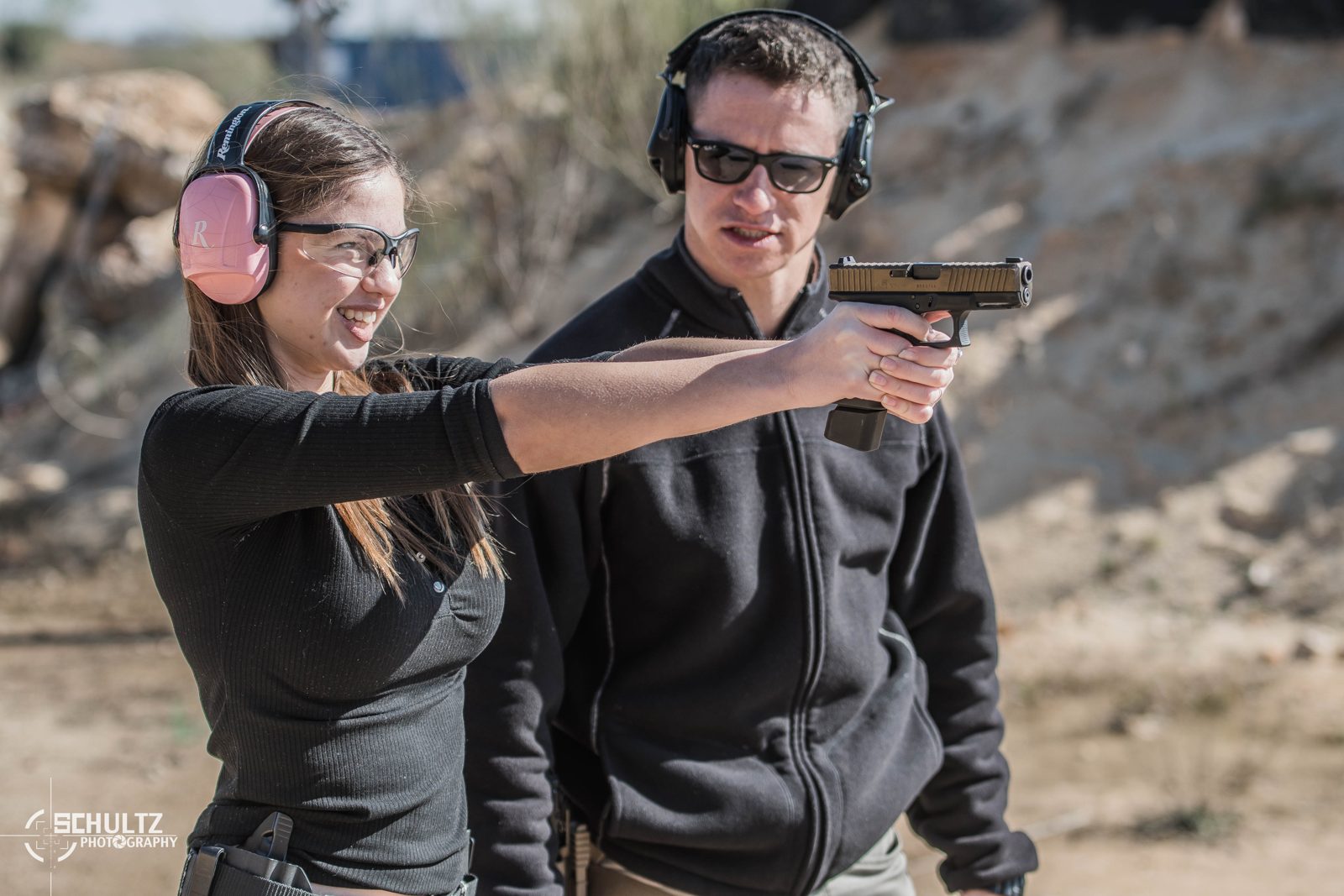
A lot of what’s marketed as women’s firearms training is generic instruction with a pink logo and a “ladies’ night” pricing structure. Real differentiation in instruction for women should come from:
- Recognizing that grip strength is typically lower — and adjusting recoil management technique accordingly. Not handing the student a .22 and calling it adapted.
- Recognizing that hand size is typically smaller — adjusting grip technique, possibly recommending a different pistol, but not assuming “she should shoot a smaller gun” by default.
- Recognizing that the social context is different — most women starting firearms training haven’t been told their whole life that “every man should know how to shoot.” That changes how to teach motivation.
The bad version of women’s firearms training: “ladies’ night” at the range with pink targets, $40 entry, 20 people on the line, every woman gets 5 minutes of personal instruction. You leave having shot 50 rounds and you can’t tell whether you’re improving.
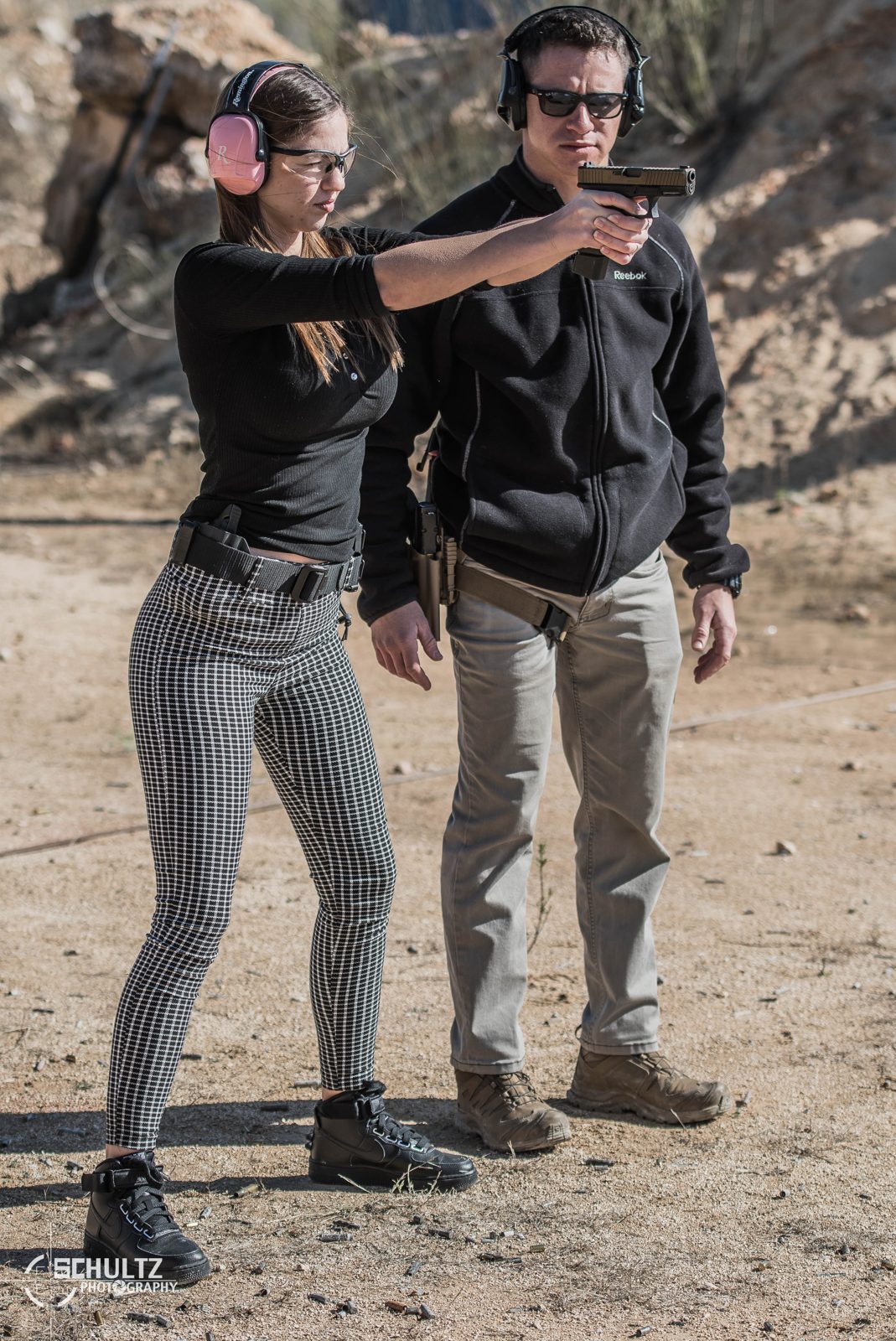
The good version: 90 minutes, 1-on-1 or small group (3-5 max), real curriculum, real feedback, real progression.
What real progression looks like (the 90-day path)
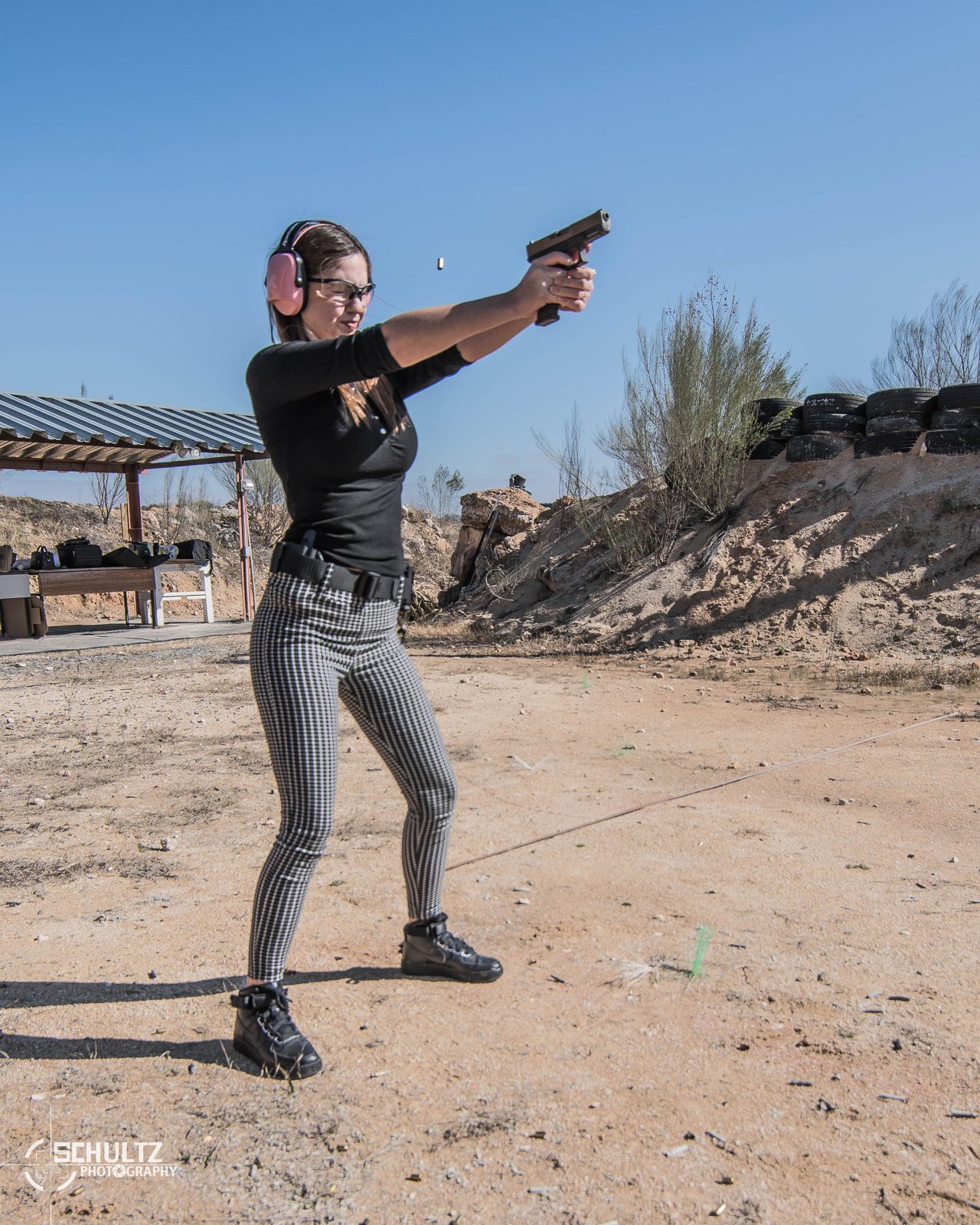
If you’re starting at zero — never handled a gun — this is the path that consistently produces a confident, competent shooter in 90 days.
Days 1-3: Fundamentals (single session, 90 minutes)
Goal: handle a pistol safely and put rounds on target at 7 yards.
- Safety protocols (four rules)
- Grip — how to actually grip a pistol (this is non-obvious and 80% of people grip wrong)
- Stance, sight alignment, sight picture
- Trigger press
- 50-100 rounds live-fire at 3 and 7 yards
End of session 1: you can safely handle, load, fire, and clear a handgun. You’re hitting an 8-inch target at 7 yards consistently.
Days 4-30: Foundation building (3-4 sessions, 90 minutes each)
Goal: consistency at 7 yards, introduction to 15 yards.
- Refine grip and stance — most students need 3-4 sessions before grip becomes automatic
- Drawing from a holster (if interested in defensive training)
- Multi-target engagement
- Reloads — both slide-lock and tactical
- Recoil management drills
- Introduce 15-yard accuracy
End of week 4: you’re shooting tight groups at 7 yards, getting hits at 15 yards, and your draw is becoming smooth.
Days 30-90: Application (4-6 sessions, varies by goal)
Goal depends on what you want:
- Concealed carry — concealment techniques, drawing from concealment, draw + first shot under 2 seconds at 7 yards
- Home defense — defensive scenarios, low-light, room clearing fundamentals
- LTC ready — focused prep for the Texas License to Carry proficiency test
- Competition entry — drills tied to USPSA or IDPA classifiers
- Just want to be a good shooter — accuracy at extended ranges, draw refinement, dot transitions
End of 90 days: you’re a competent shooter who can pass any state’s carry license test, defend yourself, and continue improving on your own with range time.
What handgun should you start with?
This is where most advice goes wrong. The default “small gun for women” recommendation produces terrible shooters because small handguns are harder to shoot.
The principles that actually matter for a beginner:
- 9mm caliber. Manageable recoil, easy to find ammo, the actual standard for self-defense in 2026.
- Full-size or compact, NOT subcompact. Service-size pistols (Glock 19, S&W M&P, CZ P-10C) have longer sight radius and lower felt recoil. They’re easier to shoot well, not harder.
- Fit the hand to the gun. If your hand is small, look at pistols with replaceable backstraps. Don’t buy a gun that doesn’t fit your hand.
The pistols we most often see women succeed with: Glock 19, Sig P365XL (compact, not subcompact), S&W Shield Plus, CZ P-10C. All 9mm, all fit a range of hand sizes, all have proven competition records.
For HOME defense (where concealment doesn’t matter): a full-size 9mm with a red dot optic is the easiest gun to shoot well. Don’t dismiss it just because it’s not concealable.
The pistols we see women struggle with most: small-frame revolvers (significant recoil, hard trigger pulls), .22 LR pistols (low recoil but build bad habits), subcompact 9mms purchased for concealability before fundamentals are established.
Why private 1-on-1 outperforms group classes for women specifically
A few patterns we’ve observed:
- More confidence to ask “stupid” questions. Most women starting out don’t want to ask the basic question in front of 11 strangers.
- Real-time correction. Group classes can’t give you the 50-round-per-session feedback density that builds skills fast.
- Pace control. Some students need 30 minutes on grip before they’re ready to fire. Others want to fire by minute 10. Group classes can’t accommodate that.
- No competitive dynamic. Group classes naturally create comparison (“she’s hitting better than me”). Private sessions remove that variable.
For most women starting from zero, the math is: 1 private 4-hour session > a generic full-day group class. The price-per-skill is much better with 1-on-1.
The instructor question
If you’re going to invest in firearms training, the instructor matters more than the venue, ammo, or guns provided.
What to look for:
- Track record with adult beginners — not just experienced shooters
- Patience with foundational work — willing to spend 20 minutes on grip if you need it
- No condescension — talks to you the same way they’d talk to a male student
- Real qualifications — Texas DPS-licensed (for LTC instruction), military / LE / professional firearms background helps, but the teaching ability matters more than the resume
- Will tell you what you’re doing wrong — bad instructors over-validate. Good instructors give specific, actionable feedback
Female instructors aren’t strictly necessary — what matters is whether the instructor talks to you like an adult learner. Many of our women students have specifically said our (male) instructors were preferred over previous experiences they’d had with women’s-marketed classes.
Common questions
I’ve never even held a gun. Is that OK?
Yes — most of our women students start from zero. By the end of session 1 you’ll be safely handling a pistol and shooting at 7 yards. That’s the entire point of fundamentals.
Will it be loud?
Yes. We provide ear protection — both passive earmuffs and electronic earpro — and most students find the volume manageable with quality protection. If you’re particularly noise-sensitive, double up (earpro + plugs).
Do I have to buy a gun first?
No. We provide pistols for the session — typically a Glock 19 or similar service pistol. Many students take 2-3 sessions BEFORE buying a gun, then buy one informed by what felt good.
Is this for concealed carry, sport, or self-defense?
All three. We tailor the curriculum to what you actually want. Most women’s training requests we get are 60% self-defense focused, 30% concealed carry, 10% sport/recreation.
What do I wear?
Comfortable closed-toe shoes, a top that fits closely at the neck (hot brass can fall into loose collars), and pants. Athletic clothing is fine. Avoid open-toe, low-cut tops, and anything you’d be sad to get powder residue on.
Can I bring a friend?
Yes — pair sessions are typically available and slightly cheaper per person than 1-on-1. Many women come for the first session with a friend.
Is it safe outdoors with weather?
We operate March-November in good weather. Heavy rain reschedules. Hot Texas summer afternoons we shift to morning sessions (before 11am).
How quickly can you book?
Most weeks, we have slots available within 7-10 days. Saturday morning slots book 2-3 weeks out.
How to book
If you’re ready to start:
- Pick a starting format — single session to try it, or commit to a 3-session foundation block (4-hour sessions)
- Pick a date — most weekdays available, Saturdays book fastest
- Show up with comfortable clothes, water, and an open mind
Contact:
- Text/call: (512) 815-9101
- Email: [email protected]
- Web: Private training inquiry →
We’ve trained hundreds of women from never-touched-a-firearm to confident, competent shooters. The first session is the only difficult one — and you’ll leave it surprised at how much you already know.
— Ron, Tactical Fitness Austin Founder
Tactical Fitness Austin runs women’s firearms training, LTC preparation, defensive pistol courses, beginner fundamentals, and concealed carry instruction. We also operate corporate events, bachelor parties, and Combat Club membership.
tacticalfitnessaustin.com · (512) 815-9101