
By Ron, Tactical Fitness Austin Founder Last updated: May 2026
TL;DR
Defensive pistol training is the gap between “I can shoot at the range” and “I can deploy my pistol effectively under real-world conditions — speed, stress, movement, multi-target, decision-making.” This guide is the actual curriculum that closes that gap, what to look for in instruction, and how we structure private defensive pistol development at Tactical Fitness Austin.
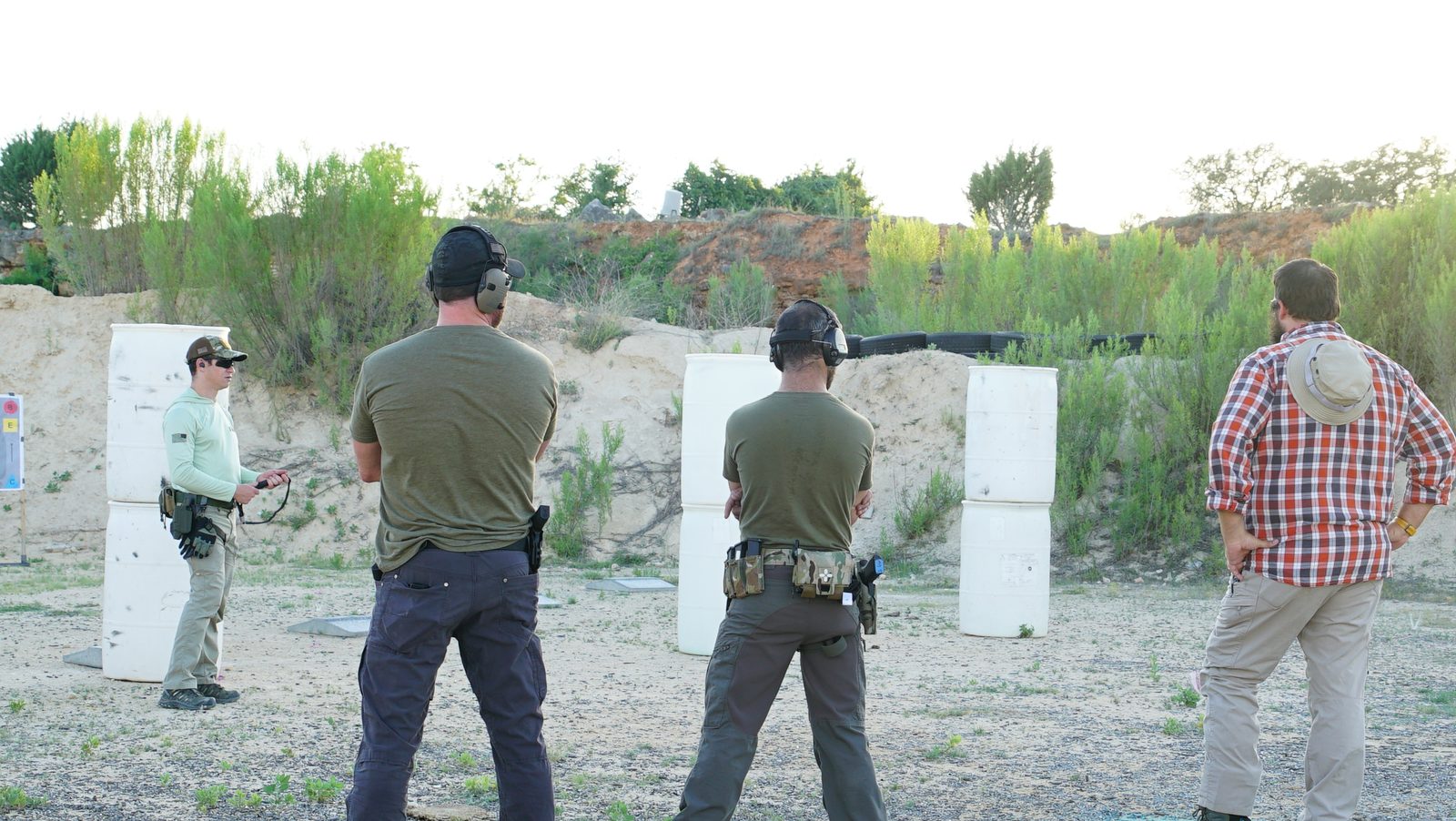
The skill gap most pistol owners don’t see
A typical pistol owner has done some combination of:
- Owned a pistol for years, shot it occasionally at a range
- Passed an LTC course and gotten the license
- Taken a 2-day “defensive pistol” course at some point
- Shoots casually at static targets at 7 yards
That’s a reasonable starting point. It’s nowhere near defensive competence.
The skills that actually matter under real defensive conditions:
- Draw from concealment in under 1.5 seconds to first hit at 7 yards
- Multi-shot accuracy — putting 3-5 shots in the A-zone in under 2 seconds
- Reload reflex — slide-lock reload in under 2 seconds without breaking the shooting cycle
- Malfunction reflex — recognizing and clearing type 1/2/3 malfunctions without thinking
- Multi-target engagement — transitioning between 2-4 targets with smooth tracking
- Movement under fire — shooting on the move, getting off the X, engaging from cover
- Decision-making under stress — recognizing threats vs. non-threats with adrenaline degraded fine motor skills
A typical pistol owner can do MAYBE 1-2 of these at the speed/accuracy real defense requires. Real defensive pistol training closes that gap systematically.
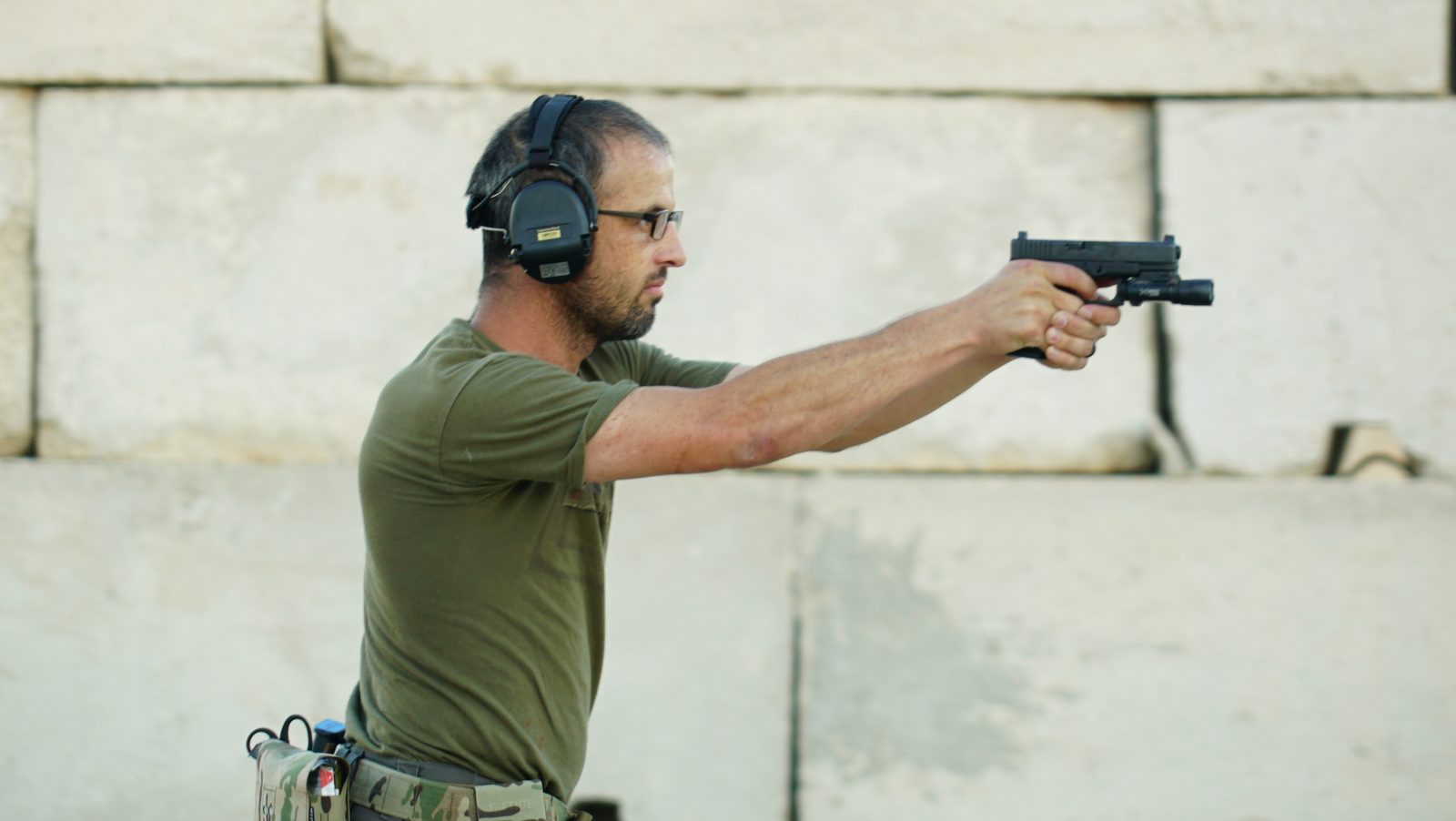
What real defensive pistol training covers
The curriculum at our level. Sessions are 4 hours, all private at our outdoor range.
Block 1 — Fundamentals refinement (1-2 sessions)
- Grip diagnosis and correction (80% of accuracy problems are grip-based)
- Stance, sight alignment, sight picture under speed
- Trigger control at the wall — eliminating overtravel and disturbance
- Recoil management — getting the dot back to target
Block 2 — Drawing under time (2-3 sessions)
- Draw from concealment (cover garment clear, grip acquisition, presentation)
- First-round accountability — every first round on target
- Targets at 7 and 15 yards
- Standards: draw + 1 shot at 7 yards under 1.5s, draw + 5 shots at 7 yards under 3s
Block 3 — Reloads and malfunctions (1-2 sessions)
- Slide-lock reload (the most common)
- Tactical reload (retain partial mag)
- Speed reload (drop the partial)
- Type 1, 2, 3 malfunction clearance
- Reload → reengage cycle without losing target acquisition
Block 4 — Multi-target and movement (2-3 sessions)
- Two-target transitions (Bill Drill variations)
- Three-target transitions
- Moving while shooting — laterally, retreating, advancing
- Engaging from kneeling, prone, behind cover
Block 5 — Stress inoculation (ongoing)
- Sprint + engage (elevated heart rate)
- Low-light shooting
- Decision-making drills (shoot/no-shoot)
Total: 3-5 four-hour sessions over 2-3 months gets a competent owner to defensive proficiency.
The standards that actually matter
You’re defensively competent when you can hit these consistently FROM CONCEALMENT:
| Drill | Standard |
|---|---|
| Draw + 1 shot at 7 yards | Under 1.5 seconds, A-zone hit |
| Bill Drill (6 shots at 7 yards) | Under 2 seconds, all hits |
| El Presidente (3 targets, 6+R+6 at 10y) | Under 8 seconds, all hits |
| 1-Reload-1 at 7 yards | Under 3 seconds |
| 25-yard accuracy (10 shots, B-8 target) | All 10 on the target |
If you can’t hit these, you’re not at defensive level yet — regardless of how long you’ve owned the pistol or how many casual range sessions you’ve done.
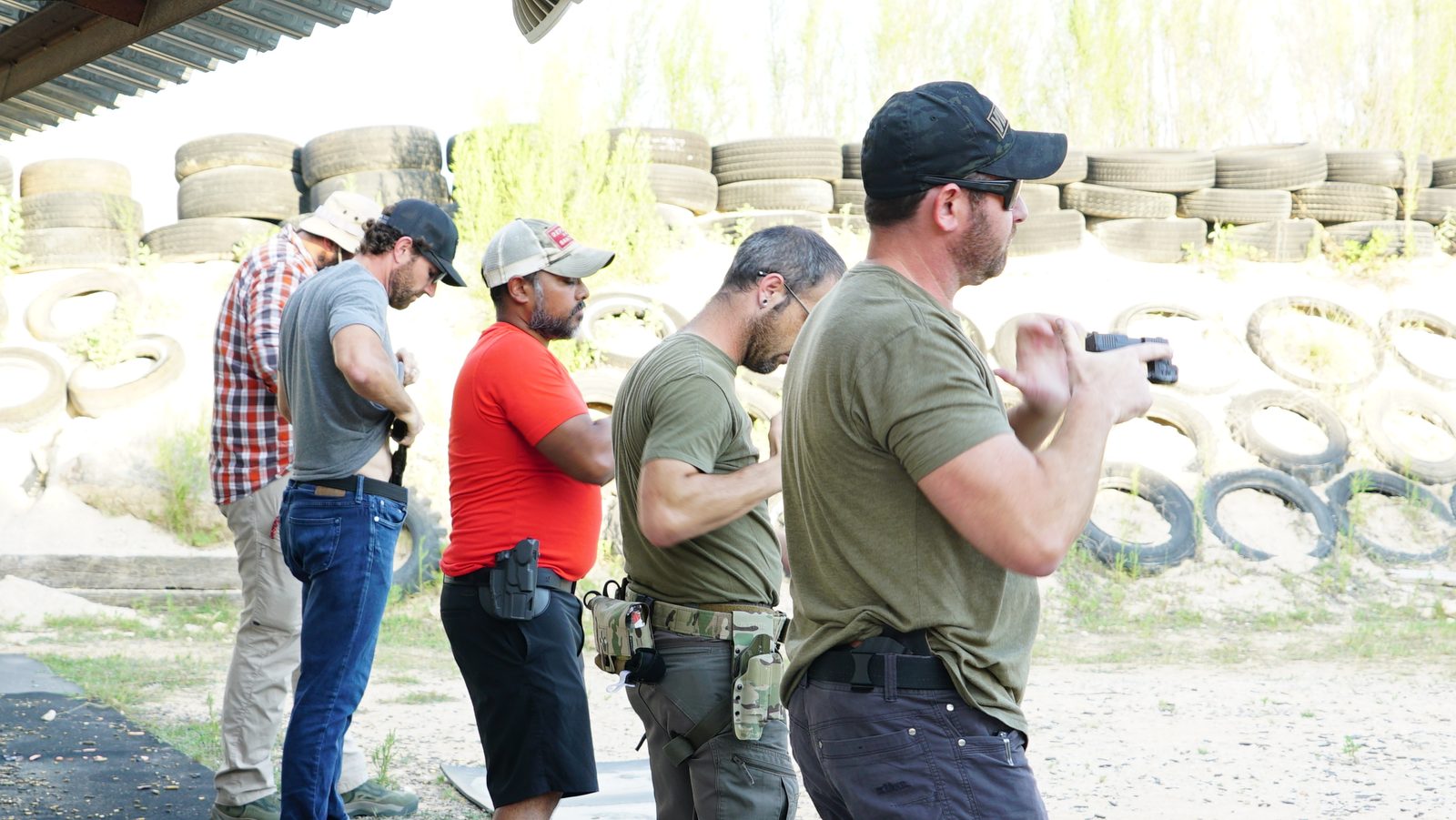
What we run
Format 1 — Private 1-on-1 (the main path)
4-hour private sessions with a TF Certified instructor. Single-shooter focus, real-time correction, customized curriculum. Most students do 3-5 four-hour sessions over 2-3 months.
Format 2 — Pair sessions
2 students with one instructor. Slightly cheaper per person, works well for couples or training partners.
Format 3 — Combat Club integration
For students past defensive baseline who want continuous development, Combat Club’s monthly rotation includes pistol-specific blocks. NOT for new shooters — Combat Club requires prerequisite competence.
Equipment
Pistol
Service-size compact 9mm is the standard. Glock 19, S&W M&P, CZ P-10C. Sub-compacts (Glock 43X, Sig P365) work but are harder to shoot fast. Full-size pistols (Glock 17) shoot best but conceal harder.
Red dot optic significantly improves performance under speed and stress. If you’re investing in defensive training, invest in a dot-ready pistol with a quality optic (Trijicon RMR, Holosun 507C, Aimpoint Acro).
Holster
Quality kydex, IWB appendix or strong-side hip, molded for your specific pistol. Tenicor, Tier 1 Concealed, Henry Holsters, Bravo Concealment. Spare mag carrier opposite the gun side.
Ammo
Quality 9mm 115gr or 124gr FMJ for training. For defensive carry, hollow-point: Federal HST, Hornady Critical Defense, Speer Gold Dot.
Common questions
How fast can I get to defensive competence?
8-12 sessions over 2-4 months with consistent dry-fire between sessions (10-15 min, 4-5 days/week). Faster if you’re already past basic fundamentals; slower if starting closer to zero.
How much should this cost?
Standard 4-hour sessions are $1,000 each. Most defensive students do 3-5 sessions (about $3,000-5,000) or join the Monthly Membership at $859/4 weeks for ongoing development. Equipment (pistol, holster, optic, ammo) adds another $500-2,000 if you need it. See full pricing here. The cost is meaningful but compares favorably to anything else that doesn’t actually protect your family.
Is one-on-one really better than group classes?
For defensive pistol specifically, yes — by a wide margin. Group classes give 5-10 minutes of personal feedback per student per class. Our private 4-hour sessions give you the instructor for the whole block. The skill development curve is dramatically faster with consistent personal correction.
What about competition shooting (USPSA, IDPA)?
Excellent supplemental training. Competition develops speed and accuracy under pressure in ways that range training can’t replicate. Doesn’t substitute for defensive scenario work — the targets and constraints in competition aren’t real-world threats. But the speed skills transfer.
Do I need to be physically fit?
You should be able to move under stress. Defensive pistol involves movement, kneeling, getting back up, sprinting short distances. Combat Club members specifically train tactical fitness alongside the shooting work for this reason.
How to start
If you’re past basic competence and want to actually develop defensive pistol capability:
- Confirm your equipment — bring your pistol, holster, carry ammo
- Book the first private session — we assess where you are and build an 8-12 session plan
- Commit to dry-fire between sessions — 10-15 minutes, 4-5 days/week
- Track your standards — measure progress against the drills above
Contact:
- Text/call: (512) 815-9101
- Email: [email protected]
- Web: Private training inquiry →
— Ron, Tactical Fitness Austin Founder
Tactical Fitness Austin offers defensive pistol training, LTC preparation, concealed carry, AR-15 / rifle training, women’s firearms training, beginner fundamentals, and Combat Club membership. We also run corporate events and bachelor parties.
tacticalfitnessaustin.com · (512) 815-9101