
By Ron, Founder of Tactical Fitness Austin
Last updated: June 2026
TL;DR
Real threats move. Real defenders need to move. But almost everyone trains standing still. Here’s why movement is a fundamental, not an advanced skill, and how to build it.
Watch most people at a shooting range.
Stand still. Aim. Fire. Reset. Aim. Fire.
None of this is how real defensive shooting works.
Real threats move. Real defenders need to move. Static shooting builds capability for scenarios that don’t exist.
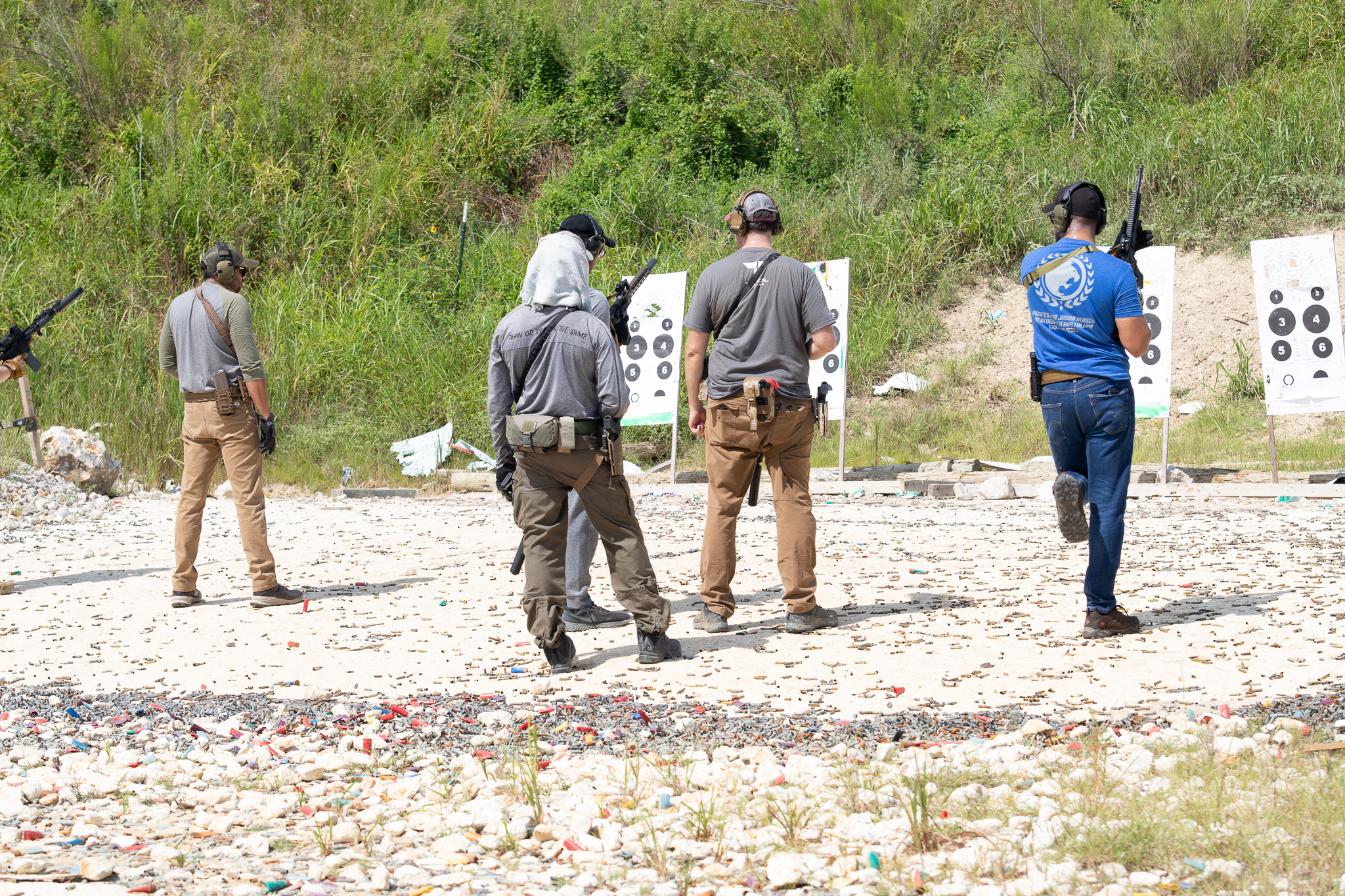
Why movement matters
In any defensive scenario, movement accomplishes critical objectives:
– Getting off the X (making you harder to hit)
– Creating distance from threats
– Moving to cover or concealment
– Preventing threats from closing distance
– Controlling the engagement geometry
Standing still while shooting is often the worst choice.
The movement skills most shooters never develop
1. Shooting while moving (directional movement)
Forward, laterally, diagonally. Each requires different mechanics: rolling step footwork, upper body stability, sight tracking compensation.
2. Moving to cover
Not just running. Moving tactically: maintaining weapon readiness, scanning while moving, using cover properly once reached, not exposing yourself unnecessarily.
3. Shooting from movement transitions
Stopping to shoot, then moving again: deceleration into a stable platform, quick accuracy under time pressure, reacquiring movement smoothly, maintaining threat awareness.
4. Movement while manipulating weapons
Reloads while moving. Malfunction clearances while moving. Transitions while moving. All significantly harder than static.
Why most people don’t train movement
- Most ranges prohibit it (liability, facility limitations)
- Requires dedicated space and safety protocols
- Demands more from your fundamentals
- Exposes weaknesses quickly
Range policies that prevent movement training leave huge capability gaps.
What proper movement training builds
1. Physiological capacity – your body learns to shoot while heart rate is elevated from physical exertion
2. Spatial awareness – you develop the ability to process your environment while focused on weapon manipulation
3. Decision-making capacity – managing multiple simultaneous tasks (shoot, move, decide)
4. Practical skill application – techniques that actually match real defensive scenarios
Training progression
Phase 1: Static accuracy fundamentals – Build the base. Standing, stable, fundamentally sound.
Phase 2: Add movement in controlled fashion – Stop and shoot drills. Move, stop, engage. Build the transitions.
Phase 3: Shoot while moving – Directional movement with engagement. Slow first, then add speed.
Phase 4: Complex movement integration – Multiple targets, multiple directions, malfunctions and reloads while moving.
Phase 5: Force-on-force application – Real decision-making, real movement, real consequences.
Most shooters are stuck at Phase 1.
Because that’s all most ranges allow. That’s all most training covers. That’s the comfort zone everyone stays in.
Breaking out requires
- A facility that allows movement training
- Instructors who can coach complex skills
- Other students at your level for interactive drills
- Time and commitment to progression
At Tactical Fitness Austin, this is what we do.
Private outdoor range with no artificial limitations on movement or direction of engagement.
Ex-special forces instructors who teach movement as a foundational skill.
Private lessons and Combat Club training that progressively builds movement capability.
If you’ve only trained static shooting, you’re missing critical defensive capability.
Movement isn’t advanced. It’s fundamental.
Train hard,
Ron
Founder, Tactical Fitness Austin
P.S. – If your range doesn’t allow drawing from holster, movement, or shooting from positions, you’re not training defensive skills. You’re training range skills. There’s a massive difference. Find a facility that lets you train reality.
Start Training (https://tacticalfitnessaustin.com/training/combat-club/)
https://instagram.com/tacticalfitnessaustin
See if you qualify for Combat Club →
Frequently asked questions
Should you shoot while moving?
In a real defensive scenario, yes. Movement gets you off the X, creates distance, and gets you to cover. Standing still while shooting is often the worst choice. But shooting on the move is a trained skill with real mechanics, not something to improvise for the first time under stress.
Why don't most shooters train movement?
Because most ranges prohibit it for liability and space reasons, it demands more from your fundamentals, and it exposes weaknesses quickly. So shooters stay in the static comfort zone, building capability for a scenario, standing still, that doesn't actually exist in a fight.
Is shooting on the move an advanced skill?
It's fundamental, not advanced; real threats move and real defenders need to. The progression goes from a sound static platform to stop-and-shoot drills, to directional movement, to complex integration. It requires a facility that allows movement and coaching to build it safely, which is what Combat Club provides.