
By Ron, Tactical Fitness Austin Founder Last updated: May 2026
TL;DR
Owning a firearm for home defense isn’t the same as being able to defend your home. The actual skills — moving through your house in low light, identifying threats vs. family members, communicating with your spouse, calling 911 while engaged, knowing what’s legal in Texas — are rarely covered by basic firearms training. This guide is what real home defense training actually involves and how we structure it.
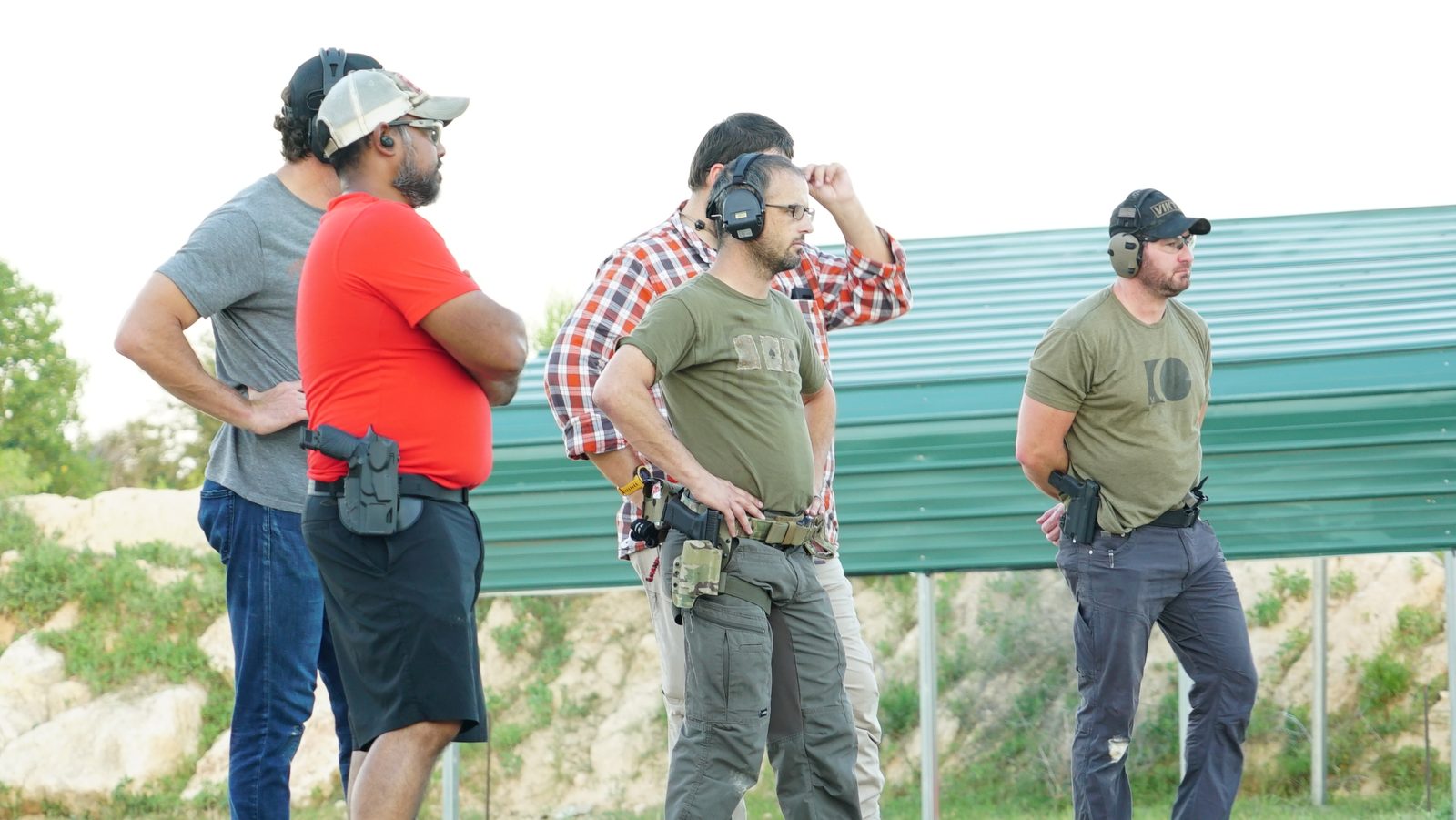
The skills home defense actually requires
A home defense scenario is fundamentally different from any range training:
- Low light or no light — most break-ins happen at night
- Familiar terrain — but you’re moving through it under stress, possibly half-asleep
- Family members present — the worst-case mistake is shooting your own kid coming home late
- Communication required — you and your spouse need a plan
- 911 in progress — phone in one hand, firearm in the other
- Legal complexity — Texas law on use of deadly force in your home is favorable but has specifics
- Cover and concealment everywhere — couches, walls, doorways all change the engagement geometry
A typical range-trained shooter has practiced none of these.
What real home defense training covers
The curriculum that closes the gap from “owns a firearm” to “can actually defend my home”:
Block 1 — Fundamentals refresh (1 session)
- Grip, stance, sight alignment under speed
- Trigger control
- Pistol selection for home defense (different criteria than carry pistol — see below)
Block 2 — Home defense scenarios (2-3 sessions)
- Movement through familiar terrain with a firearm
- Clearing rooms (when to and when NOT to — usually NOT)
- Sound discipline and signaling
- Maintaining cover and concealment in your own home
- Family member identification in low light
- Communicating with your spouse during an event
Block 3 — Low-light shooting (1-2 sessions)
- Flashlight techniques (handheld, weapon-mounted)
- Night sights / red dots for low light
- Shooting with the lights off
- Identifying threat vs. non-threat in low light
Block 5 — Legal + tactical aftermath (1 session)
- Texas use-of-force law in the home (Castle Doctrine specifics)
- 911 protocol — what to say, what NOT to say
- Securing the scene before police arrive
- Working with first responders
- Post-event interview protocol (and why you don’t talk to police without your lawyer)
Total: 3-5 four-hour sessions over 2-3 months gets a competent baseline.
What firearm should be your home defense gun?
This is where most home defense advice goes wrong. The “carry pistol” criteria (small, concealable) are NOT the home defense criteria.
The right home defense firearm
Option A: Service-size pistol with red dot + weapon light
- Glock 17 or 19, S&W M&P Full Size, CZ P-10 Full Size
- Full-size frame = lower recoil = faster follow-up shots
- Red dot optic (Trijicon RMR, Holosun 507C, Aimpoint Acro)
- Weapon-mounted light (Streamlight TLR-1, Surefire X300U)
Option B: AR-15 (carbine)
- 14.5″-16″ barrel, red dot or LPVO optic
- Weapon-mounted light
- Properly selected ammunition (55-77gr soft point or hollow point)
Option C: Pump-action shotgun (12 gauge)
- Mossberg 500/590 or Remington 870
- 18.5″ barrel, ghost ring or red dot
- Light mounted
Why NOT just use your carry pistol?
- Small-frame carry pistols (sub-compacts) shoot harder, have shorter sight radius, hold fewer rounds. Designed for concealability, not optimal performance.
- At home, concealment doesn’t matter. Optimize for performance.
- The cost of having a SEPARATE home defense gun is $500-1,000 — meaningful but reasonable insurance.
The light question — non-negotiable
Every home defense firearm needs a weapon-mounted light. You cannot: – Identify a threat in low light without illuminating it – Shoot accurately at what you can’t see – Avoid shooting your own family member coming home late if you can’t see who it is
A handheld light is a step worse — your support hand isn’t on the gun. Weapon-mounted is the standard.
What’s the home defense plan? (the conversation most couples never have)
Before training matters, the plan matters. The conversation you need to have with your spouse / household:
1. Roles
- Who is the primary armed response?
- Who calls 911?
- Who gets the kids?
- Who opens or doesn’t open the door?
2. Safe room / rally point
- Where does the family gather?
- Who stages outside that room?
- How do you signal you’re approaching the safe room?
3. Communication
- What’s your verbal challenge? (“Stop! Identify yourself!”)
- What’s the signal between you and your spouse that everything’s OK?
- What’s the signal that it’s NOT OK?
4. Phone and lights
- Where’s the phone? Multiple phones?
- What lights stay on at night?
- Where are flashlights?
5. After-action
- Who calls the lawyer?
- Who handles the kids’ trauma?
- What’s the immediate cleanup plan?
This conversation alone — done seriously — does more to prepare you than any range session. It identifies the gaps you didn’t know existed.
Common questions
Is the AR-15 better than a pistol for home defense?
For most engagements: yes, with proper ammunition selection. Lower recoil per shot, faster follow-up, more accurate beyond 7 yards, holds more rounds. The downside is maneuverability in tight spaces — but most home engagements happen at distances where the rifle’s advantages outweigh maneuverability.
Should I have a safe for the home defense gun?
Yes — but a QUICK ACCESS safe at the bedside, NOT the big safe in the closet. Quick-access safes (biometric or PIN) open in 1-2 seconds. The big safe is for everything else.
What about kids in the house?
Quick-access safe is mandatory if you have kids. Combined with age-appropriate firearms safety education (the NRA’s Eddie Eagle program is fine for young kids; teens benefit from real range time with you).
How often should I train?
Once you have a baseline: quarterly live-fire (50-100 rounds per session focused on home defense scenarios), monthly dry-fire (movement through the house, drawing from sleeping position, etc.).
Is it legal to defend my home in Texas?
Generally yes, but with specifics. Texas’s Castle Doctrine (Penal Code 9.32) protects use of deadly force against home intruders in most scenarios. Stand-Your-Ground extends to your home. But “stand my ground” doesn’t mean “shoot first, ask questions later” — Texas law still requires reasonable belief of imminent death, serious bodily injury, or commission of certain felonies.
Take the training. Know the law. Don’t rely on YouTube interpretations.
What about silencers / suppressors?
Suppressors are legal in Texas with a federal NFA tax stamp (~1-2 week wait). For home defense specifically, they reduce indoor noise from “hearing-damage-permanent” to “loud.” Worth considering for serious home defenders.
Can I just call 911 instead of engaging?
If you can safely retreat to a safe room and wait for police, yes — that’s often the best outcome. Home defense training includes when NOT to engage. Most scenarios where lethal force is justified are scenarios where you have no choice. The training helps you recognize the difference.
How much should this cost end-to-end?
Realistic budget: – Private 4-hour sessions: $1,000 each, or $859/mo membership. See full pricing. – Home defense firearm (if new): $800-1,500 – Weapon light: $150-350 – Red dot optic: $400-600 – Ammo for training: $300-500 – Quick-access safe: $150-400 –
Significant. Compares favorably to other things that protect your family less effectively.
How to start
If you want to actually be able to defend your home:
- Have the conversation with your spouse — roles, safe room, communication
- Confirm or upgrade your firearm setup — full-size pistol or AR-15 + light
- Book the first private session — we assess where you are and build a 6-8 session plan
- Run quarterly maintenance — once baseline is established
Contact:
- Text/call: (512) 815-9101
- Email: [email protected]
- Web: Private training inquiry →
— Ron, Tactical Fitness Austin Founder
Tactical Fitness Austin offers home defense training, concealed carry development, defensive pistol, LTC preparation, AR-15 / rifle training, women’s firearms training, and beginner fundamentals. We also run corporate events and bachelor parties.
tacticalfitnessaustin.com · (512) 815-9101