
By Ron, Tactical Fitness Austin Founder Last updated: May 2026
TL;DR
Most AR-15 owners can clear and load the rifle, hit paper at 50 yards, and not much else. The gap between “I own an AR” and “I can run an AR competently” is real, and it’s the gap that matters if the rifle is ever your home-defense plan, your truck gun, or your hunting tool. This guide is what AR-15 training actually covers and how we structure it for owners who want to close that gap.
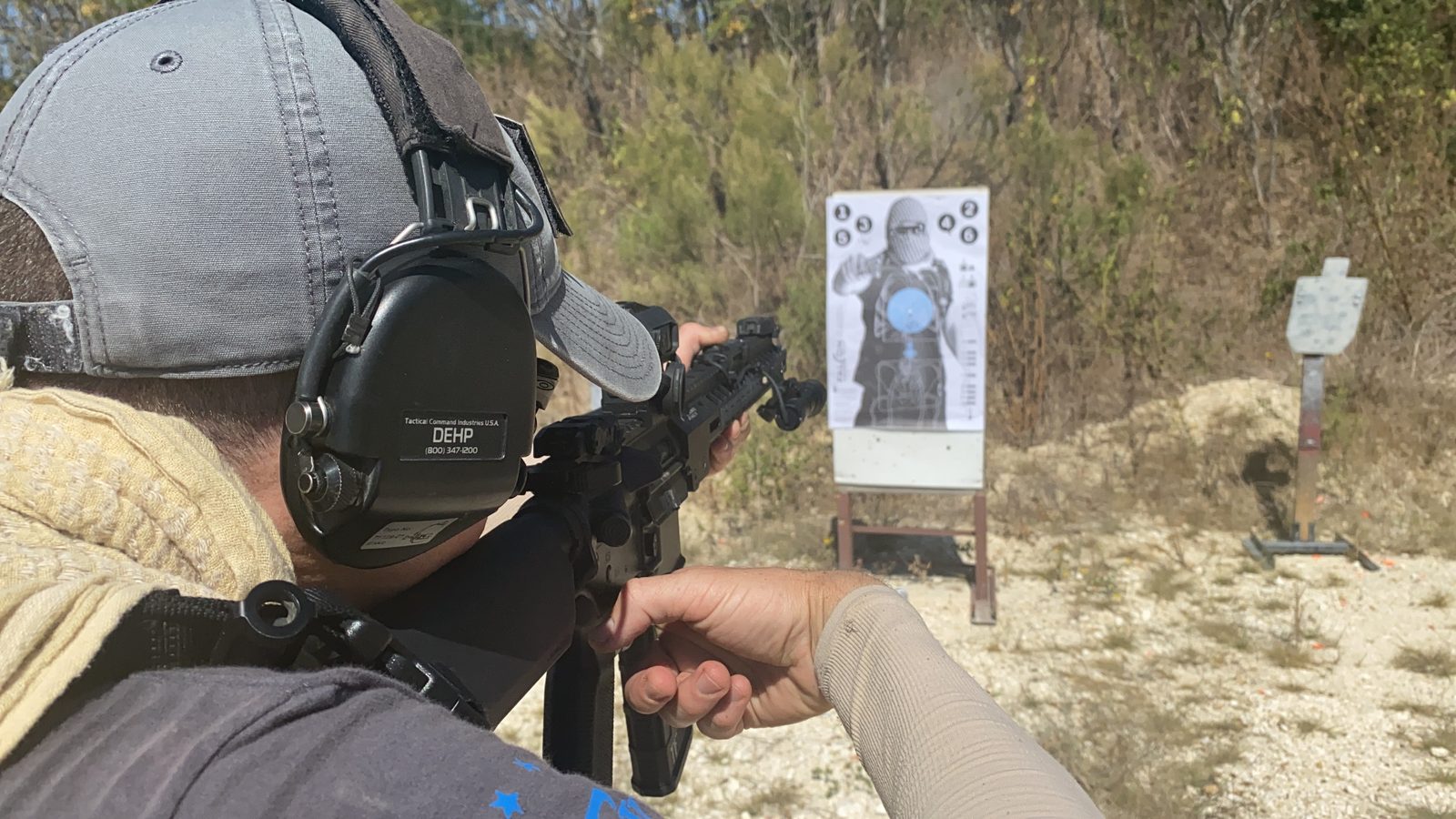
The owner-to-operator gap
A surprising number of AR-15 owners have never:
- Zeroed the rifle past the factory’s “good enough”
- Run a magazine change under any time pressure
- Cleared a malfunction beyond TAP-RACK
- Shot the rifle from anything other than a bench rest
- Engaged a target past 100 yards
- Used the rifle’s sling for support shooting
- Operated the rifle from kneeling, prone, or behind cover
- Run the optic with confidence under shifting light
Owning the rifle and operating the rifle are different things. Real AR-15 training closes the operating gap.
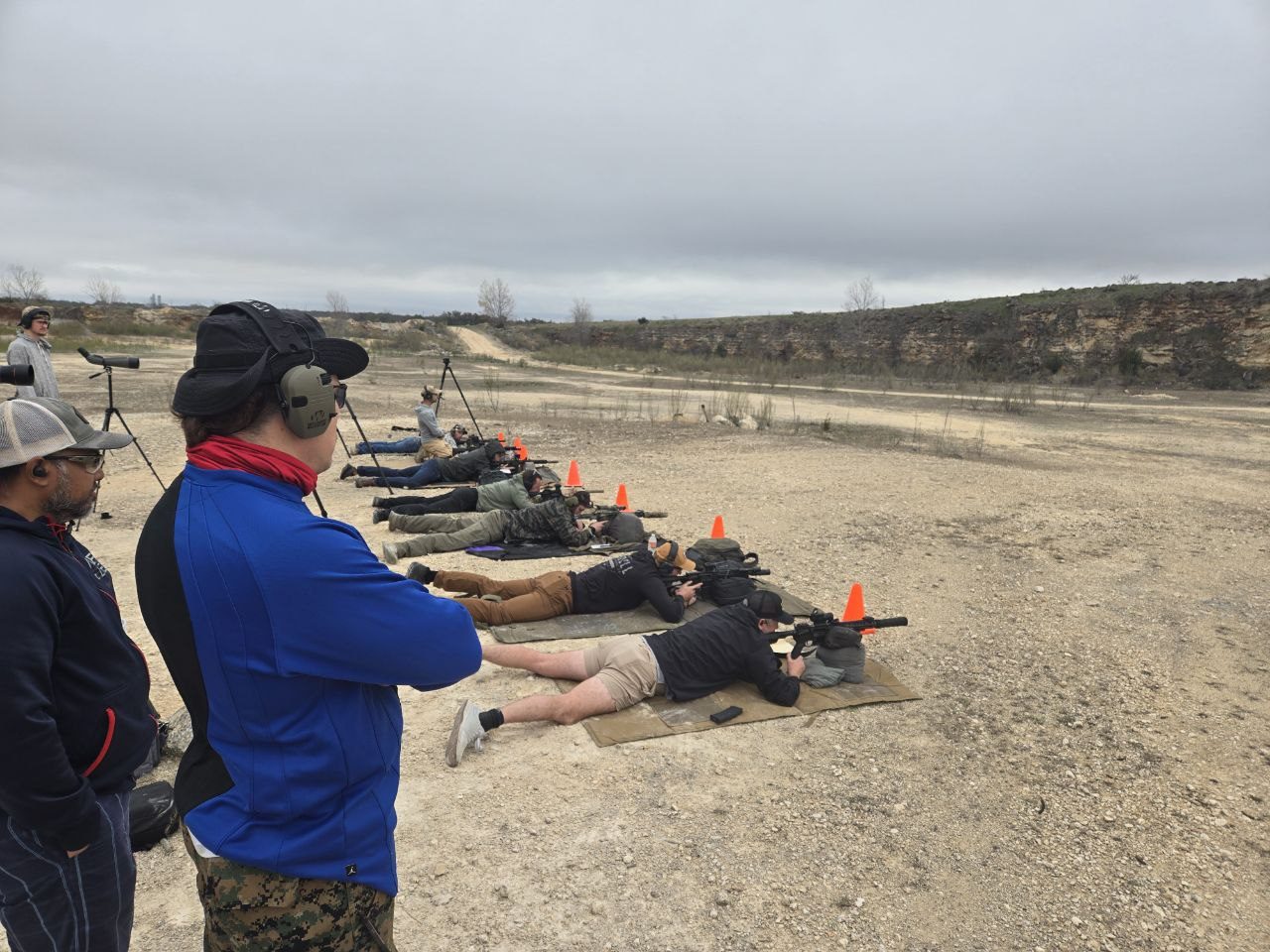
What real AR-15 training covers
The curriculum that takes an owner to functional operator looks like this:
Block 1 — Setup and zero (1 session)
- Optic mounting and torque (most home-mounted optics shift over time)
- Sling setup (two-point sling, not three-point)
- Cheek weld and head position
- 50/200 yard zero — confirms your point-of-aim aligns with point-of-impact at the distances that matter
- Functional ammunition selection (training vs. defensive)
This session alone reveals what most owners didn’t know about their rifle. Expect surprises.
Block 2 — Fundamentals (1-2 sessions)
- Grip on the AR-15 specifically (different from handgun grip)
- Stance — the modern fighting stance, squared to target
- Trigger control on a 2-stage trigger (vs. a single-stage)
- Recoil management — the AR-15 recoil pattern and how to drive the dot back to target
- Multi-shot strings at 50 and 100 yards
Block 3 — Reloads and malfunctions (1-2 sessions)
- Slide-lock reload (empty mag)
- Tactical reload (retain partial mag)
- Speed reload (drop the partial)
- Type 1 malfunction (failure to fire — TAP-RACK)
- Type 2 malfunction (failure to extract — clear, TAP-RACK)
- Type 3 malfunction (double-feed — strip mag, rack, reload, reengage)
Until reloads and malfunction clearance are reflexive, you’re not safe to deploy the rifle in any high-stakes scenario.
Block 4 — Positions and cover (2 sessions)
- Standing, kneeling, prone, squatting, rollover prone
- Shooting from awkward positions
- Using cover correctly (cover vs. concealment, deep vs. shallow)
- Sling-supported shooting positions
- Off-hand shooting (left-side cover, weak-side reload)
Block 5 — Movement (1-2 sessions)
- Moving while shooting
- Shoot, move, shoot
- Getting off the X
- Multi-target engagement with transitions
- Engaging from cover, then moving to new cover
Block 6 — Distance (1 session)
- 100, 200, 300, 400 yard accuracy
- Range estimation and holdovers
- Wind reading basics
- Position-supported precision
Total: 3-5 four-hour sessions over 2-3 months gets a competent AR-15 operator.
What the AR-15 is actually for (and what it’s not)
Honest framing — this matters for training priorities:
What the AR-15 is great at
- Home defense at common engagement ranges (5-25 yards). Lower recoil than a shotgun, faster follow-up shots, accurate beyond what shotguns and handguns can do, with proper ammunition selection less over-penetration than common defensive handgun rounds.
- Truck/property gun at 50-300 yards. Far better than a handgun for any threat past 25 yards.
- Hunting medium game (with appropriate caliber/ammo).
- Recreation and skill development. Cheap to feed (.223/5.56), reliable, modular.
What the AR-15 is bad at
- Concealed carry. Use a handgun.
- Tight indoor spaces with maneuvering required. The handgun wins here. The AR-15 wins once you have enough room.
- Hunting large game without a caliber upgrade. Default .223/5.56 is too light for elk-sized animals. Move to 6.5 Grendel, 6mm ARC, 6.8 SPC, or .300 Blackout for serious hunting.
What this means for training priorities
If your AR-15 is home defense: prioritize fundamentals + close-range work + clearing rooms (Blocks 1-3 above). If your AR-15 is a truck gun: prioritize fundamentals + 100-300 yard accuracy + positions (Blocks 1, 2, 4, 6). If your AR-15 is for hunting: prioritize fundamentals + cold-bore accuracy + position-supported shooting (Blocks 1, 2, 4, 6). If your AR-15 is for all of the above: do the full curriculum.
What we run
Format 1 — Private 1-on-1
4-hour private sessions with a TF instructor. AR-15-specific curriculum customized to your rifle’s setup and your goals. Most students do 3-5 four-hour sessions over 2-3 months.
Format 2 — Pair sessions
2-3 students with one instructor. Works well for couples, training partners, or co-property-owner duos.
Format 3 — Combat Club (for advanced shooters)
For owners past the fundamentals stage who want continuous rifle development with a small cohort, Combat Club’s monthly rotation includes rifle work. NOT for new shooters — Combat Club is application-based and has a competence prerequisite.
Common questions
What rifle should I buy if I don’t have one?
Quality, factory-built mid-tier AR-15s in 2026: BCM RECCE-16, Daniel Defense DDM4 V7, Sons of Liberty M4-89, Aero Precision M4E1. All run $1,200-2,200 out of the box and will outlast most owners’ training careers.
Avoid: ultra-budget Anderson/Bear Creek rifles for serious defensive use (they shoot fine but parts QC varies); ultra-premium $4,000+ rifles for first-time owners (better to spend that on training).
What optic?
For 0-300 yards (which is most uses): 1-6x or 1-8x low-power variable optic (LPVO). Quality brands: Vortex Strike Eagle 1-6x or 1-8x, Primary Arms SLx 1-6x, Trijicon Credo HX 1-6x. Quality red dots: Aimpoint PRO, Holosun 510C, Eotech XPS2.
What ammunition?
For defensive use: 55-77gr soft-point or hollow-point in .223 or 5.56. Quality brands: Federal Premium, Hornady, Black Hills.
For training: 55gr FMJ — cheapest reliable .223/5.56 you can find. Federal American Eagle, PMC Bronze, Wolf if you don’t mind dirty.
How often should I train?
For competence maintenance: 200-300 rounds per quarter through structured drills. For improvement: 200-300 rounds per month.
Indoor or outdoor range?
For AR-15 specifically, outdoor. Most indoor ranges in Austin can’t or won’t accommodate rifle distances, and the noise indoors with a rifle is significantly worse. We train outdoors at a private range — distances out to 300 yards available.
Suppressed fire?
If you have a suppressor (or are getting one): great. Brings the AR-15’s noise down to “loud” rather than “deafening” and removes most of the indoor-shooting limitations. We can train with suppressed rifles.
What about red dot + magnifier vs. LPVO?
Both work. LPVO has become the default for most serious AR-15 owners in 2026 because of better target identification at distance and equal speed up close with quality 1-6x or 1-8x optics. Red dot + magnifier still works but the magnifier is slower than turning an LPVO dial.
How to start
If you have an AR-15 and want to actually operate it:
- Confirm the rifle setup — bring it to the first session as-is, we’ll evaluate
- Book the first private session — we’ll start with zero, fundamentals, and a baseline assessment
- Build a 6-10 session plan based on your goals (home defense, truck gun, hunting, or all)
- Train monthly minimum to retain skills
Contact:
- Text/call: (512) 815-9101
- Email: [email protected]
- Web: Private training inquiry →
— Ron, Tactical Fitness Austin Founder
Tactical Fitness Austin offers AR-15 / rifle training, concealed carry, LTC preparation, defensive pistol, beginner fundamentals, and women’s firearms training. We also run bachelor parties, corporate events, and the Combat Club membership.
tacticalfitnessaustin.com · (512) 815-9101