
By Ron, Tactical Fitness Austin Founder Last updated: May 2026
TL;DR
A Texas LTC class teaches you what’s legal. It does not teach you what’s competent. The gap between “I have a license to carry” and “I can actually deploy a firearm under stress, on time, accurately, in a public environment with bystanders” is the gap most license holders never close. This guide is what concealed carry training actually involves once you take it seriously — and how we structure it for someone going from licensed to genuinely prepared.
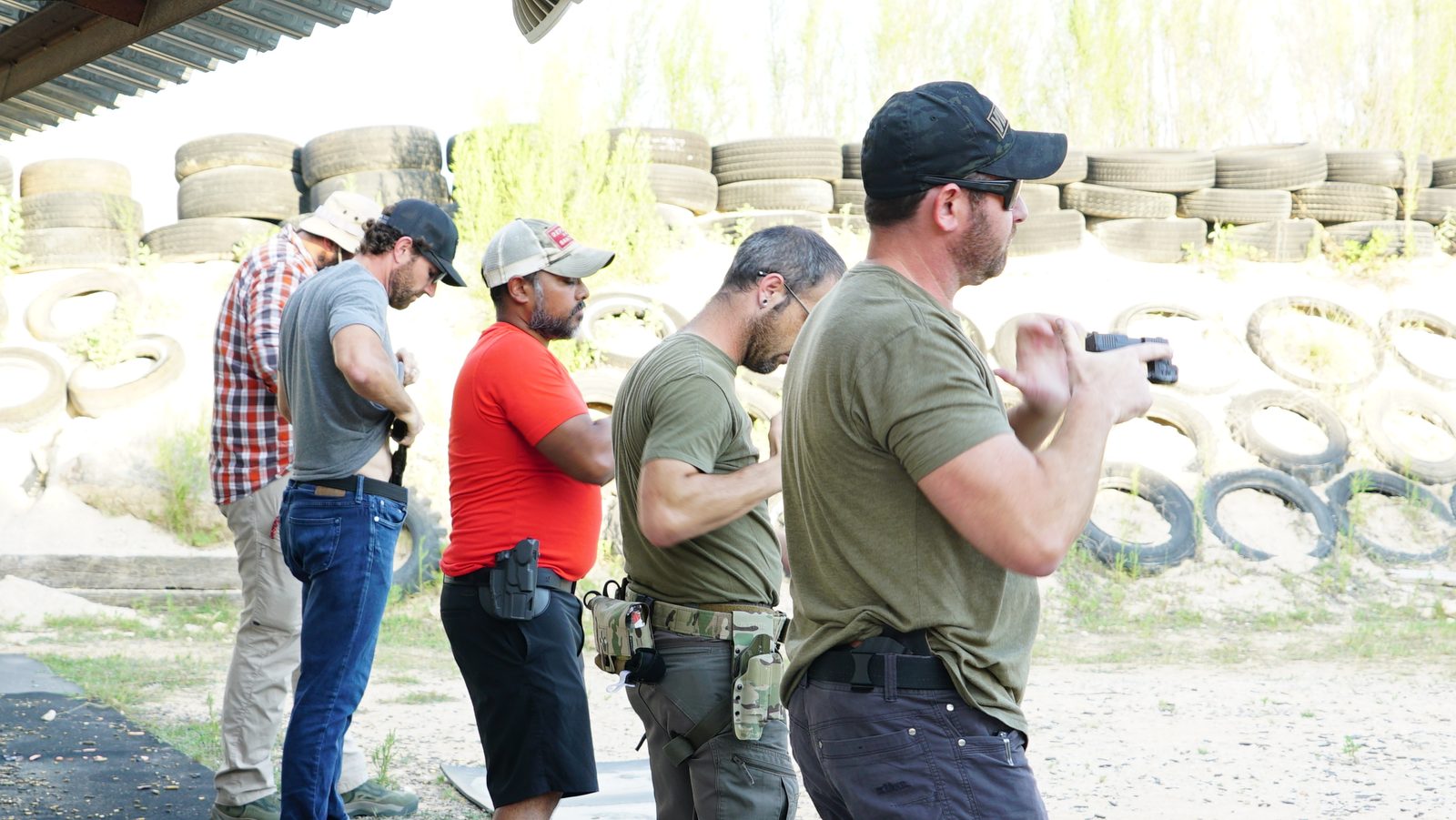
The competence gap most license holders don’t see
The Texas LTC proficiency test is 50 rounds at 3, 7, and 15 yards on a stationary target, with no time stress and no concealment. You can pass it shooting once a year at an indoor range.
The reality of carrying a concealed handgun for self-defense involves none of those conditions:
- You’re drawing from concealment — under a shirt, jacket, or behind a belt line — not from a sterile open-carry range holster
- Time matters — average civilian defensive shooting events resolve in 3-5 seconds. If your draw takes 3 seconds, you’re already behind.
- Targets move and so do you — real threats don’t stand at 7 yards
- There are bystanders — your backstop is no longer a berm, it’s a parking lot or sidewalk
- Adrenaline degrades fine motor skills — by 30-40% in untrained shooters. That trigger press you can do at the range becomes a different motion under stress.
- Decision-making is harder than shooting — knowing WHEN to draw matters more than how well you shoot
LTC training covers maybe 5% of what you actually need to carry competently. The remaining 95% is what concealed carry training proper is for.
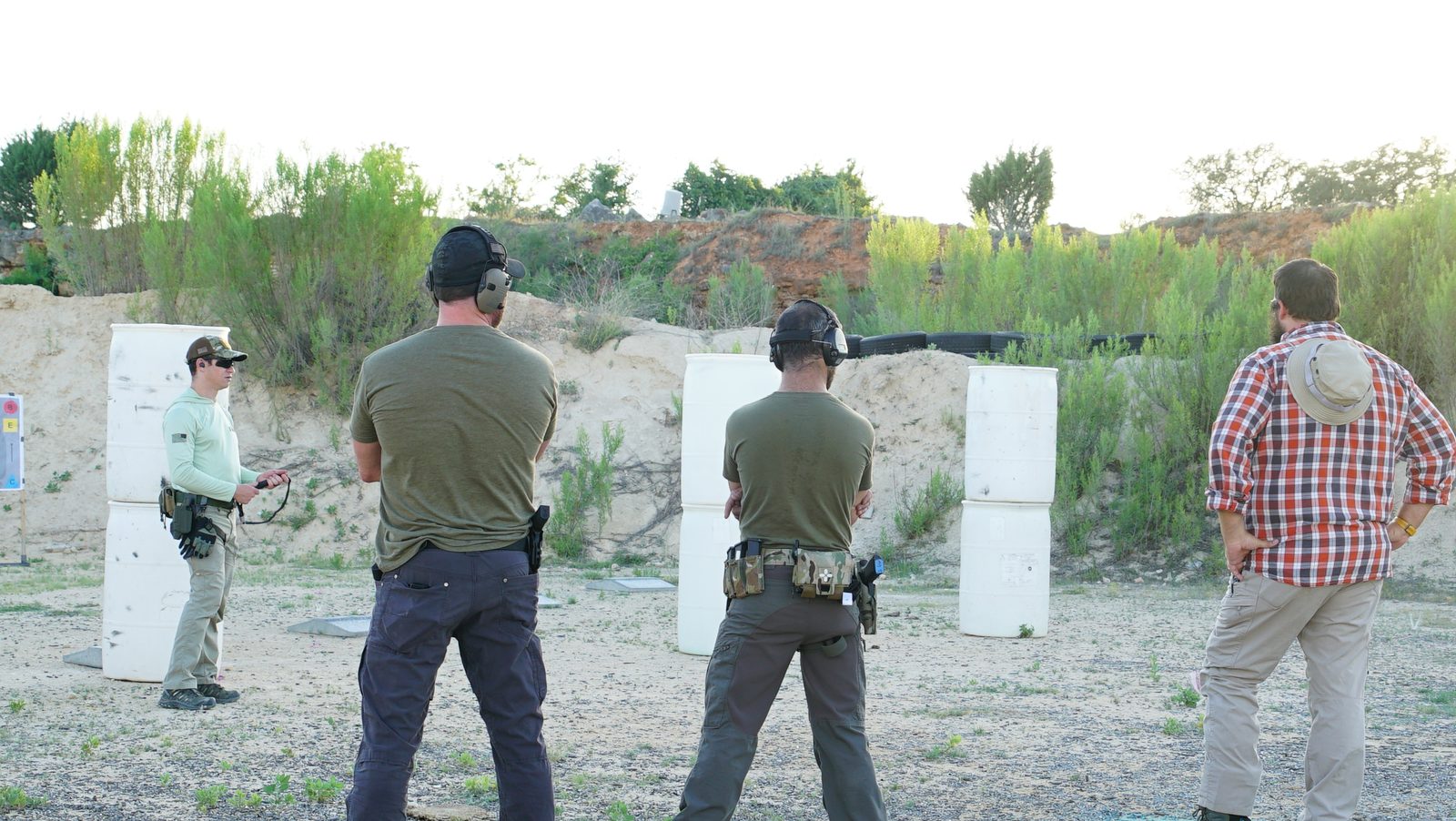
What real concealed carry training covers
The curriculum that turns a license holder into a competent concealed carrier looks like this — these are the skill blocks, in order:
Block 1 — Concealment-specific fundamentals (1-2 sessions)
- Drawing from concealment (clearing the cover garment)
- Grip acquisition during the draw (consistent under stress)
- First-round accountability — every first round on target at 7 yards, 2 seconds or less
- Holster selection that fits your daily wardrobe + body type
- Carry positions (appendix, strong-side hip, behind the back) — pros and cons of each
Block 2 — Speed under pressure (2-3 sessions)
- Timer-based drills — every drill has a par time
- 7-yard standards: draw + 1 shot in 1.5s, draw + 2 shots in 2s, draw + 5 shots in 3s
- 15-yard standards: draw + 1 shot in 2.5s
- Recoil management to keep the gun on target across multiple shots
- Reloads from concealment
Block 3 — Movement and multi-target work (2-3 sessions)
- Moving while shooting (getting off the X)
- Engaging multiple threats
- Engaging from cover
- Drawing while moving
- Shooting from awkward positions (kneeling, prone, on the back)
Block 4 — Decision-making under stress (2 sessions)
- Use-of-force scenarios — when is deadly force legal in Texas?
- Verbal de-escalation skills
- Identifying threats vs. mistakes (the most common cause of justified-shooting-turned-bad)
- Aftermath protocol — what to do in the 60 seconds after a defensive shooting
- Working with first responders
Block 5 — Stress inoculation (ongoing)
- High-heart-rate drills (sprint to firearm, then engage)
- Low-light shooting
- Shooting while injured (off-hand only, prone, etc.)
Total: 4-6 four-hour sessions over 2-4 months gets a motivated student from licensed to competent.
What we run at Tactical Fitness Austin
We offer concealed carry training in two formats:
Format 1 — Private 1-on-1 sessions
4-hour private sessions with a single instructor. Most concealed carry students do 4-6 of these (4-hour) sessions over 3-4 months. Sessions build on each other — we customize the curriculum to your specific gaps.
Best for: people who want focused training and the fastest path to competence.
Format 2 — Pair / small-group sessions
2-4 people training together, often a couple or friends. Same content as 1-on-1 but slightly slower pace. Cost is split.
Best for: spouses, training partners, families who carry together.
Either format covers Blocks 1-3 thoroughly. Blocks 4-5 (decision-making under stress) are run as occasional supplemental sessions, often jointly with multiple students.
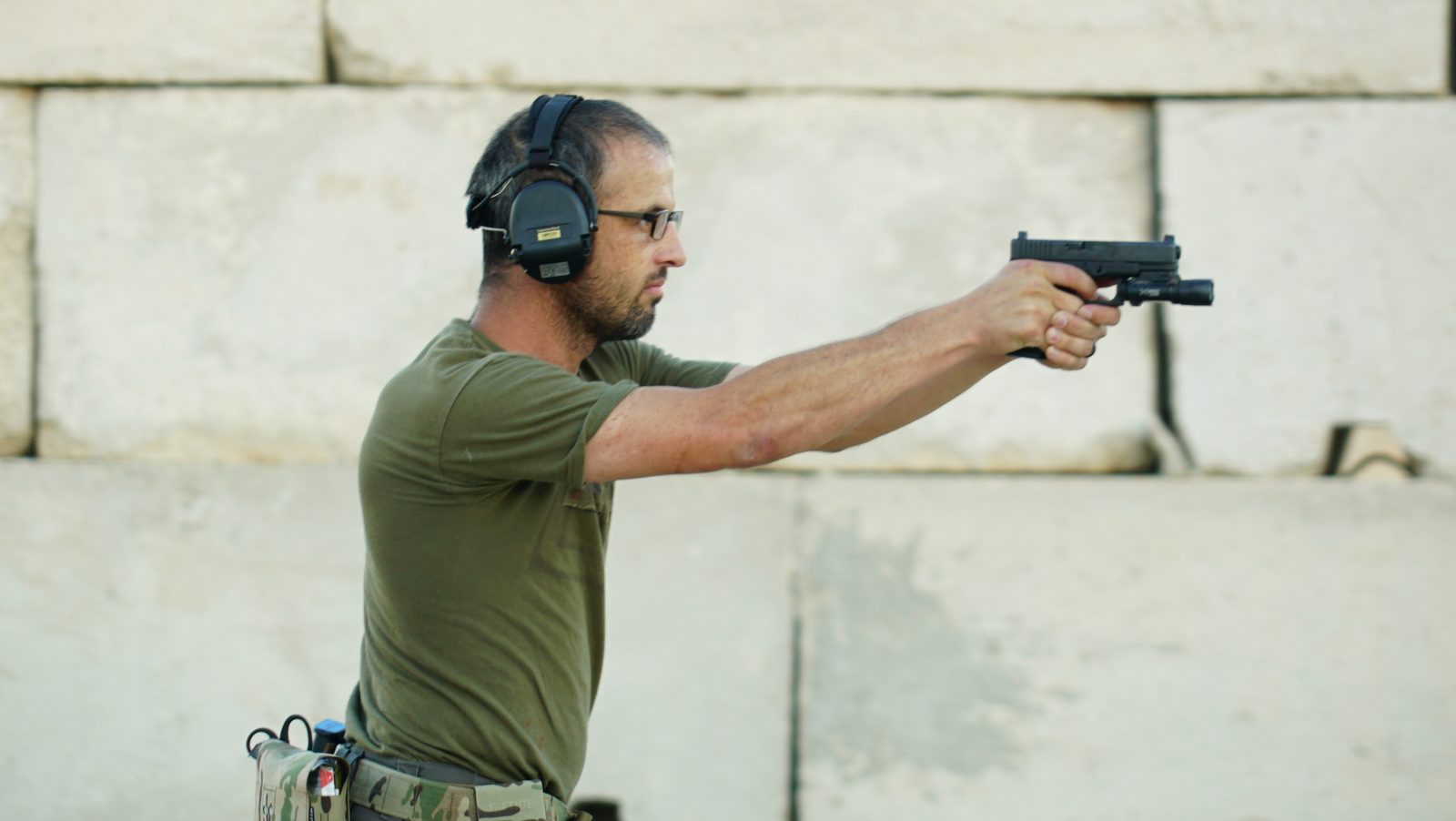
The gear question (what to actually carry)
This question gets asked early. Real answers:
Holster
- Inside the waistband (IWB) appendix carry is the most common, fastest, and most concealable for most body types. Quality brands: Tenicor, Tier 1 Concealed, Henry Holsters.
- Strong-side hip IWB is the classic — slightly slower draw than appendix but more comfortable for some. Quality brands: Bravo Concealment, T-Rex Arms.
- Avoid universal/one-size-fits-all holsters. Get one molded for your specific firearm.
- Avoid pocket carry for primary defensive carry — too slow, too imprecise.
Firearm
- Service-size compact 9mm is the modern standard. Glock 19, S&W M&P 9 Compact, CZ P-10C.
- Sub-compacts (Glock 43X, Sig P365) carry better but shoot harder. Beginner concealed carriers often start with a compact and downsize after they can shoot it well.
- Red dot optic — significantly improves speed and accuracy under stress. The data on this is conclusive in 2026. If you’re starting concealed carry from scratch, get a dot-ready pistol and the dot.
Spare magazine
- Always carry one. Most defensive shootings don’t need a reload but the malfunction-clearing benefit alone justifies it.
- Inside-the-waistband mag carrier opposite the gun side.
Light
- Pocket-carry a small flashlight (Surefire Stiletto, Streamlight Wedge). The light matters more than people think — identification before engagement is a legal and moral requirement.
How to know if you’re competent (not just trained)
Self-assessment standards. If you can hit all of these from concealment, you’re past the gap most LTC holders never close:
| Drill | Standard |
|---|---|
| El Presidente (3 targets at 10 yards, 6 shots + reload + 6 more) | Under 8 seconds, all hits |
| Bill Drill (6 shots at 7 yards) | Under 2 seconds, all hits |
| 1-Reload-1 at 7 yards | Under 3 seconds |
| 25-yard accuracy (10 shots) | All 10 on a B-8 target |
| Draw + 1 shot at 7 yards | Under 1.5 seconds, A-zone hit |
If you can hit these consistently, you’re carrying competently. If you can’t, you’re at the LTC-holder level — licensed but not competent.
Common questions
How often should I train?
Once you’re at competent baseline: minimum monthly live-fire, weekly dry-fire at home. For maintenance only. For improvement, double those.
How much does this cost end-to-end?
Cost breakdown for a serious concealed carry curriculum:
- Private 4-hour sessions: $1,000 each (Standard), $859/4 weeks (Monthly Membership, one session/month), or $3,200/4 weeks (Weekly Membership). See full pricing.
- Quality holster: $80-150
- Pistol (if you don’t have one): $500-1,000
- Red dot optic: $400-600
- Ammunition for training: $400-800 over 3-6 months
That sounds like a lot. Compare it to other things that don’t actually protect your family.
Can I learn this from YouTube?
No. The dry-fire and form fundamentals you can practice with video reference, but the live-fire skills — especially the speed-under-stress component — require feedback in real time from an instructor watching you. YouTube can show you what good looks like; it cannot tell you what YOU are doing wrong.
What about CCW classes?
Most marketed “CCW classes” are LTC classes with different branding. They teach the law and the license requirements. Few teach actual defensive skill development. If a “concealed carry class” is one day and shoots 100-200 rounds, you’re in an LTC-equivalent class. Real concealed carry training is multi-session, range-based, with timer drills.
What if I already have an LTC?
You’re at the starting line, not the finish line. Real training starts after the license.
Is appendix carry safe?
Yes, with proper technique and a quality kydex holster covering the trigger guard fully. The risk people associate with appendix carry comes from carrying with a holster that lets the trigger get bumped during reholstering. Use a real holster, train your reholster technique, and don’t reholster faster than you draw.
Texas vs. other states?
Texas law on use of force is well-defined and relatively favorable for defenders. The Castle Doctrine and Stand Your Ground are in effect. The Texas Penal Code chapter 9 is your reference — every concealed carrier should read it.
How to start
If you have your LTC and want to actually be able to use it:
- Pick your firearm — service-size compact 9mm, dot-ready preferred
- Get a quality holster — IWB appendix or strong-side hip
- Book the first private session — we’ll assess where you are and build a 6-10 session plan
- Commit to monthly live-fire + weekly dry-fire between sessions
Contact:
- Text/call: (512) 815-9101
- Email: [email protected]
- Web: Private training inquiry →
— Ron, Tactical Fitness Austin Founder
Tactical Fitness Austin offers concealed carry training, LTC preparation, defensive pistol courses, women’s firearms training, and beginner fundamentals. We also run bachelor parties, corporate events, and the Combat Club membership.
tacticalfitnessaustin.com · (512) 815-9101