
By Ron, Founder of Tactical Fitness Austin
Last updated: June 2026
TL;DR
Most carbine owners can run the rifle on a static range. Under time, movement, and stress, that breaks down fast. Here’s what training the carbine under pressure actually looks like — and why it’s the gap between owning an AR and running one.
This month’s Combat Club theme: Carbine skills.
Everyone owns an AR. Very few can actually run one under pressure.
That gap is what we worked to close.
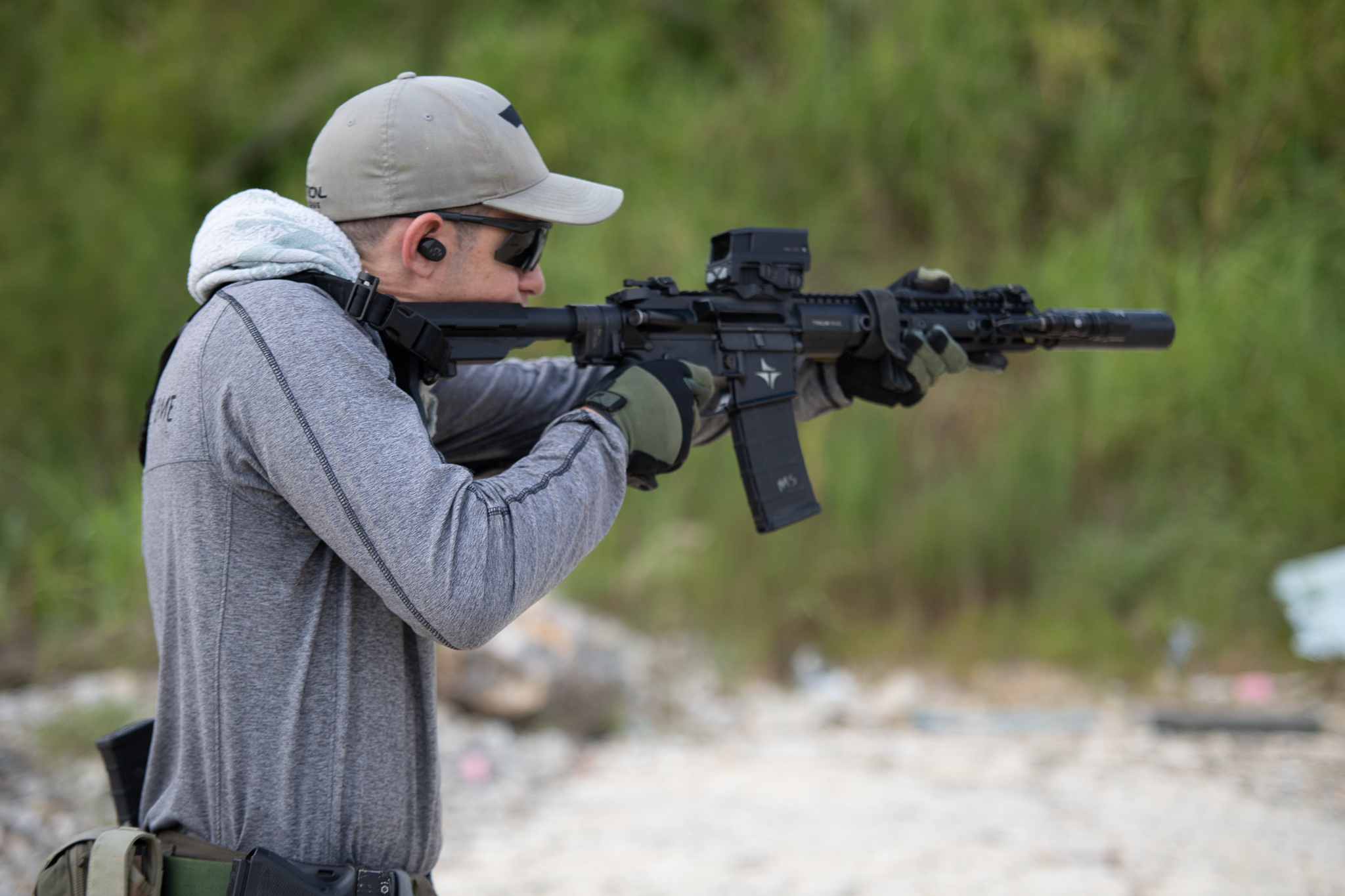
What we trained
Week 1: Fundamentals audit – zeroing, sight offset understanding, proper mounting, grip, stance. The basics most people skip.
Week 2: Transitions and reloads – moving between targets, tactical and emergency reloads, clearing malfunctions under time pressure.
Week 3: Shooting from positions – standing, kneeling, prone, urban prone, supported positions. Not every shot is standing from a stable platform.
Week 4: One handed shooting – dealing with the rifle when one arm is out of the game.
What we saw
Most students came in confident. “I know how to run an AR.”
By the end of week 1, that confidence was gone, fumbling on malfunctions, big groupings, and slow performance.
Week 2 exposed reload inefficiencies. Guys who thought their reloads were fast were shocked by timer data. What felt like 2 seconds was 5+.
Week 3 was humbling. Students who shoot accurately standing fell apart from awkward positions. Urban prone required fundamentals they’d never built.
Week 4 was a shock to the system. The difficultly of manipulating a gun one handed not only exposed a skill deficiency but also a physical deficiency.
Key takeaways
1. Owning an AR doesn’t mean you can run it. Most people have surface-level capability that evaporates under stress.
2. Sight offset matters more than most realize. At close range, your rounds don’t go where your sights point. You need to understand this.
3. Positional shooting is a separate skill. Being accurate standing says nothing about your capability from kneeling, prone, or supported positions.
4. Movement destroys marksmanship without specific training. Running carbines while moving is an entirely different skill than static shooting.
May theme: Close quarters family protection.
We only have 8 spots left in the club!
If you want in, reply “May” and I’ll send you the details.
Train hard,
Ron
Founder, Tactical Fitness Austin
P.S. – Solo range time builds basics. Combat Club builds capability under realistic constraints. Different outcomes.
Start Training (https://tacticalfitnessaustin.com/training/combat-club/)
https://instagram.com/tacticalfitnessaustin
See if you qualify for Combat Club →
Frequently asked questions
What's the difference between owning an AR-15 and running one?
Most owners can load, clear, and hit paper at 50 yards. Running a carbine means presenting it fast, managing recoil for quick follow-ups, reloading and clearing malfunctions without looking, and shooting from kneeling, on the move, and through turns, under stress. That's a trained skill set, not a function of ownership.
Is square-range practice enough for rifle skills?
It builds a base, but a static range never makes you move, decide, or perform with an elevated heart rate. Real capability comes from training the rifle under pressure with other students and coaching, which is what Combat Club at Tactical Fitness Austin is built for.
What does carbine training under pressure cover?
Presentation, recoil mitigation, shooting cadence, tactical and emergency reloads, malfunction clearances, shooting from positions like kneeling, and movement skills such as turns, pivots, and shoulder switching, all trained under time and stress rather than static slow fire.